ÁVILA, BORIC, AND THE END OF THE ALLENDIST YOUTH MODELÁVILA, BORIC Y EL FIN DEL MODELO ALLENDIANO DE JUVENTUD
It should alarm us deeply that the lead singer of a band goes on a powerful TV host's YouTube channel (also a former network executive, let's remember, which underscores his reach) imitating another singer's way of speaking. It's just as troubling that a former president can only call the sitting president an "imbecile" through the imitator's voice (see here).
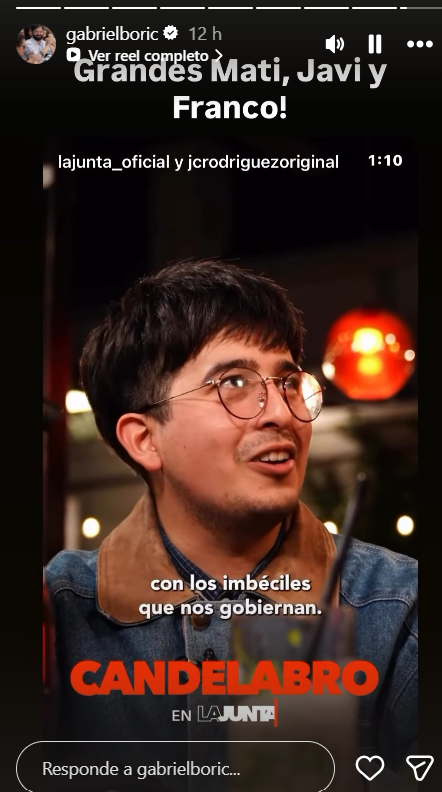 Boric's screenshot
One imitating another who in turn shares the imitation: this game of v3ntriloquists shows just how sad the political-aesthetic stage we live on has become. It seems nobody can utter a single word without someone else having performed it first. When everything is wrong, someone has to stand up and say so — to name what's new about what's wrong, because things are never wrong in the same way or for the same historical reasons twice. That's the circuit needed for what's new to produce political action.
And yet today it seems nobody can speak unless there was a first speaker before them. And since there's never really a first, nobody speaks. In this case, it turns out there was a first — except he was talking about something else, for another audience, in another context.
Matías Ávila and Gabriel Boric share the same fate, even if they belong to different generations. They are proof of the p3rformative impotence of the contemporary Chilean left (and international left too, why not say it).
While we can enjoy the little thrill of someone calling Kast an imbecile, we can't feel the same way watching the thousands who pack Candelabro's concerts stay off the streets, not carrying out any other kind of political action. Instead, they seem content to snipe on X or Instagram, filters on, voices put on, defending their artists like they were heroes of the revolution. Let's be naive for a second and imagine all of them actually took to the streets under some circumstance. Would it change anything? Of course not. It wouldn't, because their fans alone aren't enough to cause change — not in numbers, not in political savvy, and let's not even start on their distaste for emerging leadership and their fear of making decisions. For those who don't listen to Ávila and company, the past and its icons don't mobilize or inspire anything beyond nostalgia.
In the short viral clip, Ávila — imitating Jorge González and shaking that little noisy thing (I can't tell what it even is, but it's maddening) — assembles a bunch of elements at once: the bodily posture in the head-turn, the vocal inflection and the wardrobe, the classic rebellious discourse, faith in the future as a worn-out trope, the populist appeal through the near-priesthood of being a teacher, neurodivergence, criticism of the first world, a certain national pride, etc. That somatic and discursive assemblage does produce effects, no doubt — just not the ones the moment actually needs.
On one hand, it mobilizes memory: the mockery some make of his impression, built on comparisons with previous talks he's given, can only land if you remember how González actually spoke. On the other, it mobilizes an action just as performative as his own: Boric shares that interview clip in a tone every bit as put-on as his performer's.
The thing is, Boric is as rebellious as a young artist. When Boric manages to call Kast an imbecile between the lines, what he's doing is reproducing an empty gesture, the kind that comes from not caring about consequences. The former president doesn't know how to do anything else. When he was in power, he loved presenting himself as a poet, an eminent orator full of symbolism. Boric has always had that tendency toward the tableau vivant of the historical figure. He shares that with Ávila too, because by imitating González, he's voicing his own wish to be historic the way González was.
So we have to ask ourselves whether it's right that one of the supposed leaders of the contemporary left, one of the supposed levees holding back the gale of pauperizing, reactionary right-wing policy, acts the way some kid with enormous fame acts.
Another terrible thing about this whole situation is that it's Boric who follows Ávila, and not the other way around. The former president caves: for him, all the power he once held (did he ever really hold it?) isn't what matters, isn't what's needed. What matters is the country's future, which he claims is within his reach and that he knows well, because he trusts it (and of course he's got pole position to lead it, since he knows them up close). And he performs hard to convince us of it, calling them by their nicknames: "Mati, Javi, and Franco." He is, in effect, still a kid himself.
Because a truth that's breathing right behind our ear, stalking us wherever we look, needs to be said: Chile's problems don't need young people to solve them. The Allendista model of youth as the driver of political change no longer works, because the conditions are different now: young people only know how to be fans, artists only dare to imitate, and political leaders refuse to make decisions, delegating them onto the young instead. Nobody is a v3ctor. When Allende praised the youth, he knew he himself was the vector of change: he owned the consequences of his own actions.
How pathetic Boric looks sharing that clip, and how sad Ávila looks imitating a musical hero of the past, are just symptoms of the r0ttenness of that model of political action. What's needed, no doubt, is another one.
Boric's screenshot
One imitating another who in turn shares the imitation: this game of v3ntriloquists shows just how sad the political-aesthetic stage we live on has become. It seems nobody can utter a single word without someone else having performed it first. When everything is wrong, someone has to stand up and say so — to name what's new about what's wrong, because things are never wrong in the same way or for the same historical reasons twice. That's the circuit needed for what's new to produce political action.
And yet today it seems nobody can speak unless there was a first speaker before them. And since there's never really a first, nobody speaks. In this case, it turns out there was a first — except he was talking about something else, for another audience, in another context.
Matías Ávila and Gabriel Boric share the same fate, even if they belong to different generations. They are proof of the p3rformative impotence of the contemporary Chilean left (and international left too, why not say it).
While we can enjoy the little thrill of someone calling Kast an imbecile, we can't feel the same way watching the thousands who pack Candelabro's concerts stay off the streets, not carrying out any other kind of political action. Instead, they seem content to snipe on X or Instagram, filters on, voices put on, defending their artists like they were heroes of the revolution. Let's be naive for a second and imagine all of them actually took to the streets under some circumstance. Would it change anything? Of course not. It wouldn't, because their fans alone aren't enough to cause change — not in numbers, not in political savvy, and let's not even start on their distaste for emerging leadership and their fear of making decisions. For those who don't listen to Ávila and company, the past and its icons don't mobilize or inspire anything beyond nostalgia.
In the short viral clip, Ávila — imitating Jorge González and shaking that little noisy thing (I can't tell what it even is, but it's maddening) — assembles a bunch of elements at once: the bodily posture in the head-turn, the vocal inflection and the wardrobe, the classic rebellious discourse, faith in the future as a worn-out trope, the populist appeal through the near-priesthood of being a teacher, neurodivergence, criticism of the first world, a certain national pride, etc. That somatic and discursive assemblage does produce effects, no doubt — just not the ones the moment actually needs.
On one hand, it mobilizes memory: the mockery some make of his impression, built on comparisons with previous talks he's given, can only land if you remember how González actually spoke. On the other, it mobilizes an action just as performative as his own: Boric shares that interview clip in a tone every bit as put-on as his performer's.
The thing is, Boric is as rebellious as a young artist. When Boric manages to call Kast an imbecile between the lines, what he's doing is reproducing an empty gesture, the kind that comes from not caring about consequences. The former president doesn't know how to do anything else. When he was in power, he loved presenting himself as a poet, an eminent orator full of symbolism. Boric has always had that tendency toward the tableau vivant of the historical figure. He shares that with Ávila too, because by imitating González, he's voicing his own wish to be historic the way González was.
So we have to ask ourselves whether it's right that one of the supposed leaders of the contemporary left, one of the supposed levees holding back the gale of pauperizing, reactionary right-wing policy, acts the way some kid with enormous fame acts.
Another terrible thing about this whole situation is that it's Boric who follows Ávila, and not the other way around. The former president caves: for him, all the power he once held (did he ever really hold it?) isn't what matters, isn't what's needed. What matters is the country's future, which he claims is within his reach and that he knows well, because he trusts it (and of course he's got pole position to lead it, since he knows them up close). And he performs hard to convince us of it, calling them by their nicknames: "Mati, Javi, and Franco." He is, in effect, still a kid himself.
Because a truth that's breathing right behind our ear, stalking us wherever we look, needs to be said: Chile's problems don't need young people to solve them. The Allendista model of youth as the driver of political change no longer works, because the conditions are different now: young people only know how to be fans, artists only dare to imitate, and political leaders refuse to make decisions, delegating them onto the young instead. Nobody is a v3ctor. When Allende praised the youth, he knew he himself was the vector of change: he owned the consequences of his own actions.
How pathetic Boric looks sharing that clip, and how sad Ávila looks imitating a musical hero of the past, are just symptoms of the r0ttenness of that model of political action. What's needed, no doubt, is another one.
Nos debería exhortar fuertemente que el vocalista de una banda salga en una entrevista en el canal de YouTube de un poderoso animador (también fue ejecutivo de canal, recordemos, lo cual destaca su poder) imitando en la forma de hablar a otro cantante. También es problemático que un expresidente solo pueda decirle "imbécil" al presidente en funciones mediante la voz del imitador (véase aquí).
El pantallazo de Boric
Uno imitando a otro quien a su vez comparte la imitación: este juego de v3ntrílocuos muestra la tristeza del escenario político-estético en que vivimos. Parece que nadie puede expresar una palabra sin que otro la haya performado primero. Cuando todo está mal, hay alguien que debe pararse y decirlo, decir la novedad de lo que esta mal porque no siempre se está mal de la misma manera y por las mismas razones históricas. Este es el circuito necesario para que lo nuevo produzca acción política.
Sin embargo, hoy parece que nadie puede hablar si no hubo antes un hablante primero. Y como nunca hay primero, nadie habla. En este caso, resulta que si hubo un primero, pero estaba hablando otra cosa, para otro público, en otro contexto.
Matías Ávila y Gabriel Boric comparten, aunque sean de generaciones distintas, un mismo sino. Ellos son la demostración de la impotencia p3rformática de la izquierda chilena (e internacional, por qué no decirlo) contemporánea.
Si bien podemos alegrarnos y divertirnos porque alguien le dice imbécil a Kast, no podemos sentir lo mismo al ver que los miles que llenan los conciertos de Candelabro no están en la calle o ejecutando otro tipo de acció política. En cambio, parece que solo se quedan a chistar en X o Instagram, con sus filtros y sus expresiones impostadas y defendiendo a sus artistas como si fueran héroes de la revolución. Seamos inocentes y creamos por un momento que todos ellos estuvieran en la calle en alguna circunstancia. ¿Tendría efecto? Por supuesto que no. No será así porque sus fans solos no bastan para provocar cambios (por número e inteligencia política y ni hablar de su tirria por la emergencia de liderazgos y su miedo a la toma de decisiones). Para los que no escuchan a Ávila y compañía, el pasado y sus referentes no movilizan ni inspiran más que en el recuerdo.
En el video de corta duración que se ha viralizado, Ávila, imitando a Jorge González y moviendo esa cosita que mete bulla (que no logro identificar qué es, pero que es desesperante) ensambla varias cosas: la disposición corporal representada en el giro de la cabeza, la inflexión de la voz y el vestuario, el discurso contestatario clásico, la confianza en el futuro como tópico manido, la referencia popular vía el apostolado que supone ser docente, la neurodivergencia, la crítica al primer mundo, cierto orgullo de país, etc. Ese ensamblaje somático y discursivo logra efectos, sin duda, pero no los necesarios para el contexto que se vive.
Por un lado, moviliza el recuerdo: la burla que algunos hacen de su imitación con base en comparaciones de anteriores intervenciones habladas que ha dado solo puede tener lugar si se recuerda cómo habló González, por ejemplo. Por otro, moviliza la acción tan performática como la de él: Boric comparte ese extracto de entrevista en un tono tan impostado como su performer.
Es que Boric es tan rebelde como un artista joven. Cuando Boric es capaz de decir entre líneas que Kast es un imbécil, lo que hace es reproducir la acción vacía, propia de la desconsideración de las consecuencias. El expresidente no sabe hacer otra cosa. Cuando estaba en el poder, le fascinaba mostrarse como un poeta y un orador insigne y lleno de símbolos. Boric siempre ha tenido esa tendencia al tableau vivant de personaje histórico. En eso también comparte con Ávila porque, al imitar a González, está diciendo su deseo de ser histórico como lo fue este último.
Entonces tenemos que preguntarnos si es correcto que uno de los supuestos líderes de la izquierda contemporánea, uno de los supuestos diques de contención contra el vendaval de medidas pauperizadoras y reaccionarias de la derecha, actúe como actúa un mozuelo con fama ingente.
Otra cosa terrible de esta situación es que es Boric quien sigue a Ávila y no al revés. El expresidente capitula: para él, todo el poder que tuvo (¿lo tuvo?) no es lo importante ni lo necesario. Lo importante es el futuro del país, que lo tiene al alcance de la mano y lo conoce bien, porque confía en él (y por supuesto tiene la pole position para liderarlo porque los conoce de cerca). Y él performa con fuerza para convencernos porque los trata por sus apócopes: "Mati, Javi y Franco". Él es, en efecto, todavía un joven.
Pues una verdad que nos respira tras el oído y que nos asecha a donde veamos debe ser dicha: los problemas de Chile no necesita a los jóvenes para ser solucionados. El modelo allendiano del joven como movilizador del cambio político ya no funciona porque las condiciones son distintas: los jóvenes solo saben ser fans, los artistas solo se atreven a imitar y los líderes políticos renuncian a tomar decisiones delegándolas en los jóvenes. Nadie es un v3ctor. Cuando Allende ensalzaba a los jóvenes sabía que él era el vector de cambio: asumía las consecuencias de sus actos.
Lo patético que se ve Boric compartiendo eso y lo triste que se ve Ávila imitando a un prócer musical pasado son solo señales de la p0dr3dumbre de ese modelo de acción política. Se necesita, sin duda otro.
El pantallazo de Boric
Uno imitando a otro quien a su vez comparte la imitación: este juego de v3ntrílocuos muestra la tristeza del escenario político-estético en que vivimos. Parece que nadie puede expresar una palabra sin que otro la haya performado primero. Cuando todo está mal, hay alguien que debe pararse y decirlo, decir la novedad de lo que esta mal porque no siempre se está mal de la misma manera y por las mismas razones históricas. Este es el circuito necesario para que lo nuevo produzca acción política.
Sin embargo, hoy parece que nadie puede hablar si no hubo antes un hablante primero. Y como nunca hay primero, nadie habla. En este caso, resulta que si hubo un primero, pero estaba hablando otra cosa, para otro público, en otro contexto.
Matías Ávila y Gabriel Boric comparten, aunque sean de generaciones distintas, un mismo sino. Ellos son la demostración de la impotencia p3rformática de la izquierda chilena (e internacional, por qué no decirlo) contemporánea.
Si bien podemos alegrarnos y divertirnos porque alguien le dice imbécil a Kast, no podemos sentir lo mismo al ver que los miles que llenan los conciertos de Candelabro no están en la calle o ejecutando otro tipo de acció política. En cambio, parece que solo se quedan a chistar en X o Instagram, con sus filtros y sus expresiones impostadas y defendiendo a sus artistas como si fueran héroes de la revolución. Seamos inocentes y creamos por un momento que todos ellos estuvieran en la calle en alguna circunstancia. ¿Tendría efecto? Por supuesto que no. No será así porque sus fans solos no bastan para provocar cambios (por número e inteligencia política y ni hablar de su tirria por la emergencia de liderazgos y su miedo a la toma de decisiones). Para los que no escuchan a Ávila y compañía, el pasado y sus referentes no movilizan ni inspiran más que en el recuerdo.
En el video de corta duración que se ha viralizado, Ávila, imitando a Jorge González y moviendo esa cosita que mete bulla (que no logro identificar qué es, pero que es desesperante) ensambla varias cosas: la disposición corporal representada en el giro de la cabeza, la inflexión de la voz y el vestuario, el discurso contestatario clásico, la confianza en el futuro como tópico manido, la referencia popular vía el apostolado que supone ser docente, la neurodivergencia, la crítica al primer mundo, cierto orgullo de país, etc. Ese ensamblaje somático y discursivo logra efectos, sin duda, pero no los necesarios para el contexto que se vive.
Por un lado, moviliza el recuerdo: la burla que algunos hacen de su imitación con base en comparaciones de anteriores intervenciones habladas que ha dado solo puede tener lugar si se recuerda cómo habló González, por ejemplo. Por otro, moviliza la acción tan performática como la de él: Boric comparte ese extracto de entrevista en un tono tan impostado como su performer.
Es que Boric es tan rebelde como un artista joven. Cuando Boric es capaz de decir entre líneas que Kast es un imbécil, lo que hace es reproducir la acción vacía, propia de la desconsideración de las consecuencias. El expresidente no sabe hacer otra cosa. Cuando estaba en el poder, le fascinaba mostrarse como un poeta y un orador insigne y lleno de símbolos. Boric siempre ha tenido esa tendencia al tableau vivant de personaje histórico. En eso también comparte con Ávila porque, al imitar a González, está diciendo su deseo de ser histórico como lo fue este último.
Entonces tenemos que preguntarnos si es correcto que uno de los supuestos líderes de la izquierda contemporánea, uno de los supuestos diques de contención contra el vendaval de medidas pauperizadoras y reaccionarias de la derecha, actúe como actúa un mozuelo con fama ingente.
Otra cosa terrible de esta situación es que es Boric quien sigue a Ávila y no al revés. El expresidente capitula: para él, todo el poder que tuvo (¿lo tuvo?) no es lo importante ni lo necesario. Lo importante es el futuro del país, que lo tiene al alcance de la mano y lo conoce bien, porque confía en él (y por supuesto tiene la pole position para liderarlo porque los conoce de cerca). Y él performa con fuerza para convencernos porque los trata por sus apócopes: "Mati, Javi y Franco". Él es, en efecto, todavía un joven.
Pues una verdad que nos respira tras el oído y que nos asecha a donde veamos debe ser dicha: los problemas de Chile no necesita a los jóvenes para ser solucionados. El modelo allendiano del joven como movilizador del cambio político ya no funciona porque las condiciones son distintas: los jóvenes solo saben ser fans, los artistas solo se atreven a imitar y los líderes políticos renuncian a tomar decisiones delegándolas en los jóvenes. Nadie es un v3ctor. Cuando Allende ensalzaba a los jóvenes sabía que él era el vector de cambio: asumía las consecuencias de sus actos.
Lo patético que se ve Boric compartiendo eso y lo triste que se ve Ávila imitando a un prócer musical pasado son solo señales de la p0dr3dumbre de ese modelo de acción política. Se necesita, sin duda otro.